
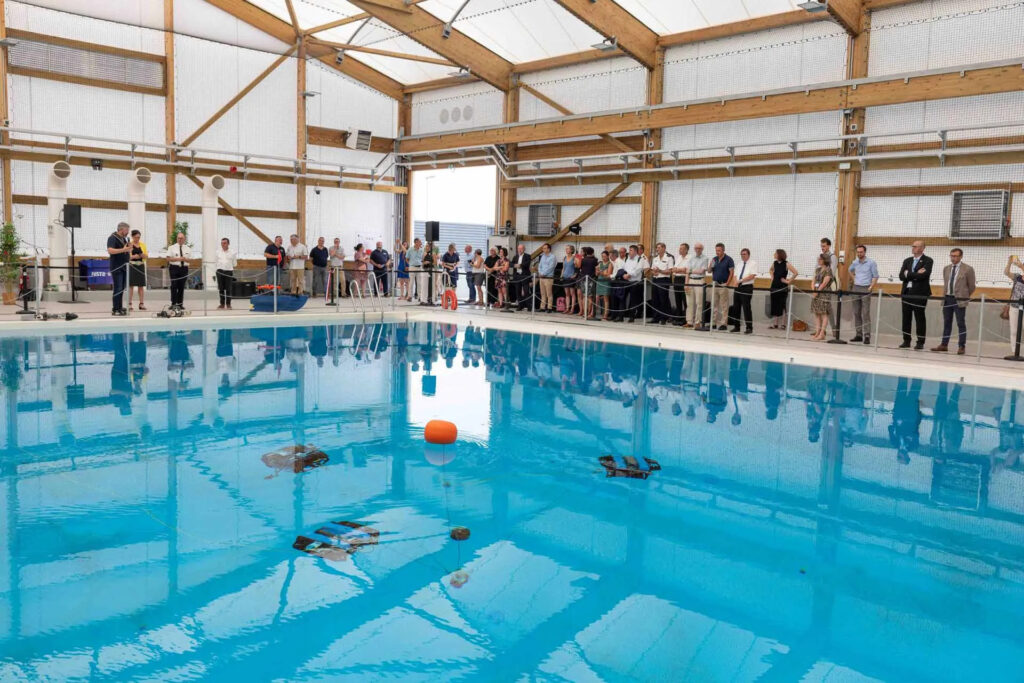
A major milestone for marine engineering and autonomous ocean technologies was reached on 24 June 2026 with the inauguration of the new Air-Sea Experimental Facility at the ENSTA Brest campus. Developed as part of the 2021–2027 Contrat de Plan État-Région (CPER), this one-of-a-kind research infrastructure is designed to bridge the gap between laboratory experiments and real-world ocean operations.
The facility combines a large experimental basin with an indoor drone flight arena, allowing researchers to test integrated air, surface, and underwater autonomous systems within the same environment. One of its most distinctive features is its permeability to satellite signals, enabling realistic testing of navigation, communications, and positioning systems that are normally only possible during expensive field deployments at sea.
A laboratory for the ocean technologies of tomorrow
The new platform has been designed to support the next generation of autonomous ocean observation systems, including underwater gliders, autonomous surface vehicles (ASVs), aerial drones, and robotic sensor networks. By reproducing operational conditions in a controlled environment, researchers can validate new technologies, develop coordinated multi-platform missions, and improve the reliability of autonomous systems before deployment in the ocean.
Beyond robotics, the facility will contribute to a broad range of applications, including:
- Ocean observation and environmental monitoring
- Marine robotics and autonomous navigation
- Coastal and offshore engineering
- Defence and maritime security
- Digital twins and numerical model validation
- Development of future multi-domain observation systems
Strengthening France’s marine research capabilities
The inauguration reflects ENSTA’s growing role within the French marine research landscape. Since joining the Institut Polytechnique de Paris, ENSTA has reinforced its activities in marine engineering and recently established the Interdisciplinary Center for Seas and Ocean (CIMO) together with Ifremer and other national partners. The new experimental basin complements these initiatives by providing a cutting-edge facility where engineers, researchers, students, and industrial partners can collaborate on innovative solutions for ocean science and technology.
Accelerating innovation through collaboration
As ocean observation increasingly relies on fleets of autonomous platforms working together, infrastructures such as the Air-Sea Experimental Facility become essential. They reduce development costs, shorten testing cycles, and enable safer experimentation before field operations. With this unique facility, ENSTA offers Europe an exceptional environment where new concepts can be evaluated under realistic conditions, helping accelerate innovation in autonomous marine systems while strengthening collaborations between academia, industry, and public institutions.