


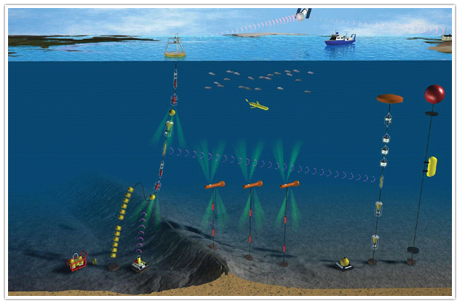
Continental shelf seas are typically less than 200 m deep and can be described by the shallow ocean surrounding continental land masses.
View more →Seeks to understand and predict how change in sea ice and ocean properties will affect the large-scale ecosystem structure of the Arctic Ocean.

Cooperative project with partners from Senegal, France, Germany, Cape Verde, and other West African countries, started January 2013.
Three-dimensional circulation and transport within the south-eastern Bay of Biscay from a multi-platform approximation.
View more →IMOS glider mission in the region of Bicherno in the eastern coast of Tasmania.
View more →
Aims to better understand how heat and salt is transported from the Arabian Sea and how these processes influence the monsoon.
Bothnian Sea water exchange monitoring program.
IMOS glider missions surveying marine life in the submarine canyons off Bremer Bay, Western Australia.
View more →IMOS glider missions in the Cairns Area, across and along the Great Barrier Reef, Queensland, Australia.
View more →Repeated section across the Balearic current between Balearic Island and Iberian peninsula.
View more →IMOS glider missions in the Capes Current area, Western Australia.
View more →
Teledyne Glider mission across the globe, demonstrating the capability of Slocum Gliders to cross long distances.
View more →
ISMAR — Institute of Marine Sciences, National Research Council of Italy, Venice.
View more →
Towards Coast to Coast Networks of marine protected areas, from the shore to the high and deep sea, coupled with sea-based wind energy potential.
View more →Marine Autonomous and Robotic Systems program at the National Oceanography Centre, Liverpool.
View more →IMOS glider missions in the Cooktown area, along and across the Great Barrier Reef, Queensland, Australia.
View more →IMOS glider mission in the Coral Sea along and across the Great Barrier Reef.
View more →Coastal Observing System for Northern and Arctic Seas — an integrated ocean observing system.
View more →
Investigation of isolated low oxygen water masses near the Cape Verde Archipelago in the open ocean.
View more →Sub-regional forecasting and observing system in the Eastern Mediterranean Levantine Basin, covering coastal and open sea areas of Cyprus.
View more →IMOS glider mission in the vicinity of Dampier Harbor, North Western Australia.
View more →Deep ocean convection observations using an adaptive network of underwater gliders.

Flow in the eastern subpolar North Atlantic, an important component of the global thermohaline circulation with a key role in regulating climate.
View more →Ocean Gliders Facility, Integrated Marine Observing System (IMOS), Crawley, Western Australia.
View more →
Advancing understanding of the interplay between clouds, convection and circulation and their role in climate change.
View more →Improves understanding of exchange processes taking place at ocean–shelf boundaries in the North East Atlantic.
View more →IMOS glider missions in the vast area of the Great Australian Bight, South Australia.
View more →Robotic ocean gliders deployed in the Agulhas Current to better understand how energy dissipates in the ocean off the east coast of South Africa.
View more →Arctic phytoplankton bloom dynamics and the marine carbon cycle study using gliders.
Innovation project focused on the Atlantic Deep Ocean observation framework.

Integrated Arctic Observation System supporting environmental monitoring and research across the Arctic region.
View more →
Provides coordinated free trans-national access to coastal research infrastructures operated by the JERICO NEXT consortium.
View more →IMOS glider deployment in the Kimberly area, North Western Australia.
View more →
Glider research program at Kyungpook National University, Daegu, South Korea.
View more →IMOS glider mission in the Leeuwin Cape area, Western Australia.
View more →Study of coast-to-open-sea exchanges via a network of underwater gliders (gliders), applied to the Gulf of Lion.
View more →IMOS glider missions across and along the Great Barrier Reef, Queensland, Australia.
View more →Long-term glider mission dedicated to the environmental characterization of oceanographic areas.

Glider missions in the Lofoten Basin, Norwegian Sea, operated with Alseamar-ALCEN technology.
View more →Mission comprising oceanographic data collection with a focus on passive acoustic monitoring of marine mammals.
View more →Autonomous measurement of coastal turbidity as an index of water clarity using underwater gliders.
View more →
European project focused on marine environment monitoring and security across European seas.
Mediterranean forecasting system aimed at environmental predictions for the Mediterranean Sea.

A decennial program to observe, understand and predict the habitability of the Mediterranean basin over a century.
View more →
Combines Eulerian observatories and autonomous mobile platforms to enhance Mediterranean observation.
View more →
Research initiative comprising nine Helmholtz research centres focused on modular Earth system observation.
View more →IMOS glider missions in the Ningaloo area, North Western Australia, Indian Ocean.
View more →Nordic program for environmental monitoring and observing system integration.
IMOS glider missions on the New South Wales continental shelf.
View more →Ocean climate survey along the southern section of the Rockall Trough.

Develops an interoperable and cost-effective platform integrating networks of observing and forecasting systems across the Mediterranean basin.
View more →Improves understanding of mixing and sub-mesoscale processes beneath the ocean surface.
View more →
International program providing a continuous record of full-water-column, trans-basin fluxes of heat, mass and freshwater in the subpolar North Atlantic.
View more →
Assesses the dual impact of human activity and natural pressures on the Mediterranean and Black Seas.
View more →IMOS glider deployment in the Perth Canyon area offshore Perth, Western Australia.
View more →IMOS glider missions in the Pilbara area of North Western Australia.
View more →
Annual glider school at PLOCAN, Gran Canarias Island, teaching new users how to handle underwater glider technology.
View more →IMOS glider missions in the vicinity of Portland Harbor, Victoria, Australia.
View more →
Glider deployments related to the PREFACE project on tropical Atlantic climate prediction.
View more →
Cooperation between SHELL Brasil, LAMCE/COPPE/UFRJ and PROOCEANO for oceanographic monitoring off Brazil.
View more →Glider program at the Bermuda Institute of Ocean Sciences (BIOS), St. George's, Bermuda.
View more →Investigates mixing generated by internal tides over steep ocean seabed topography, such as mid-ocean ridges, and its role in biogeochemistry.
View more →Italian flagship research program for marine science, with glider deployments coordinated through Oregon State University.
View more →IMOS glider mission in the vicinity of Rowley Island, North Western Australia.
View more →
Gliders deployed from R/V METEOR cruise M148 to study the Southwest African coastal upwelling system.
View more →IMOS glider mission in the Spencer Gulf, Southern Australia.
View more →Southwest Pacific ocean circulation and climate experiment using underwater gliders.

Aims to reduce uncertainty in process understanding of the cycling of nutrients and carbon in shelf seas.
IMOS glider deployment in the bay of Hobart, south of Tasmania.
View more →The Norwegian Atlantic Current serves as a conduit of warm and saline water from the North Atlantic to the Arctic Ocean.
View more →IMOS glider deployment in the Two Rocks area — multi-platform project with moorings.
View more →Draws together existing UK marine observatories and observing programmes to create new knowledge from marine data.
Regional experiment studying interactions between the ocean, clouds, atmosphere and land in the Southeast Pacific.