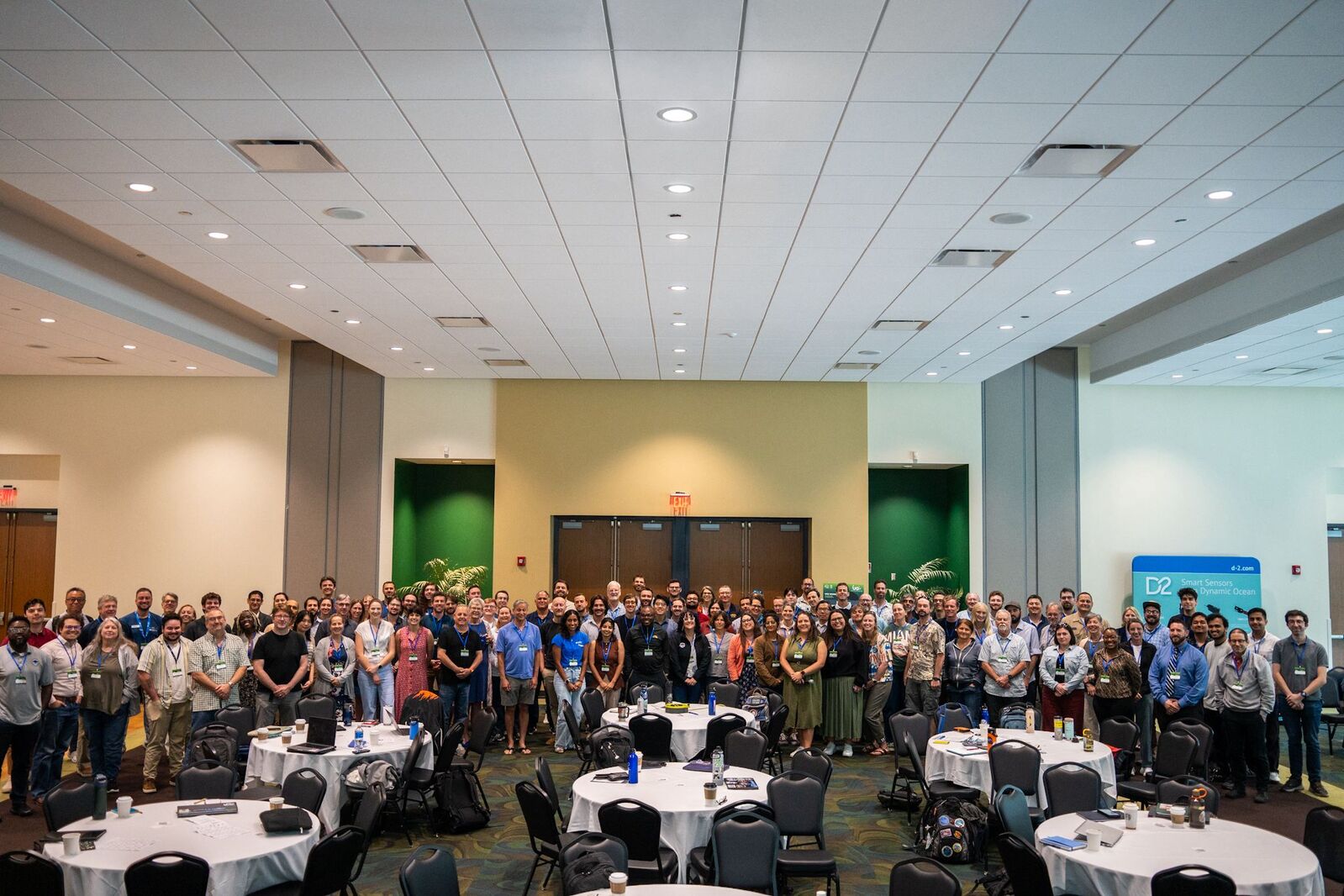
The Underwater Glider User Group (UG2) Workshop 2026, held in St. Petersburg, Florida, brought together the international underwater glider community for three days of scientific presentations, technical discussions, breakout sessions, poster sessions, vendor demonstrations, and networking opportunities. Hosted at the University of South Florida (USF), the workshop once again demonstrated how collaboration across institutions and countries is driving innovation in autonomous ocean observing.
The meeting opened with a warm welcome from Chad Lembke and the USF team. Their hospitality was particularly inspiring given that the laboratory had recently experienced a devastating fire. Despite the damage, the team managed to save their fleet of gliders and successfully hosted the international community, reflecting the resilience and dedication that characterize the glider community.
Throughout the workshop, participants shared the latest advances in glider technology and applications, highlighting how autonomous underwater vehicles have become essential tools for ocean observation. One particularly interesting presentation was given by Miguel Terniero from CICESE’s GMOG programme (Mexico), who presented the extensive use of gliders in Mexican waters. His work demonstrated how gliders are increasingly being deployed to observe extreme weather events and improve our understanding of rapidly changing ocean conditions. Robert Todd from WHOI presented the long-term monitoring of the Gulf Stream using Spray gliders. These sustained observations are providing unprecedented insights into one of the world’s most important ocean circulation systems, improving both scientific understanding and ocean forecasting capabilities.
Several breakout sessions focused on the expanding range of glider applications. Discussions explored how gliders are now routinely used for marine ecosystem monitoring, including fisheries and living marine resources. Participants highlighted the growing integration of active acoustic systems, such as echosounders for biomass estimation, together with passive acoustic sensors used to monitor marine mammals. These developments are opening new opportunities for ecosystem-based management and future marine resource assessments.
Another exciting presentation came from Ben Allsup of the National Oceanography Centre (NOC), who showcased work on expanding glider capabilities through digital twin technologies. By combining observations with advanced numerical models, digital twins have the potential to improve ocean forecasts while helping determine the optimal routes and sampling strategies for autonomous gliders. Elliss Keener Lacroix, representing the Ocean Tracking Network (OTN), presented innovative work on automating Slocum glider behaviour based on geographic location. He also described collaborative efforts to monitor the critically endangered North Atlantic right whale, where glider observations contribute to reducing ship strikes by providing near-real-time information on whale presence.
Regional observing systems also featured prominently during the meeting. Barbara Kirkpatrick presented the extensive collaborative glider programme operating across the Gulf of Mexico through partnerships involving NOAA, USF, USM, GERG, CICESE, and GMOG, demonstrating how coordinated observing systems can support both science and operational oceanography. One of the highlights was the presentation by Travis Miles, who described recent advances in hurricane monitoring and Loop Current forecasting. Following recent successful deployments, gliders have now been officially recognized as an essential hurricane monitoring tool within the United States’ national emergency response framework. Their ability to collect subsurface ocean observations before and during tropical cyclones is significantly improving hurricane intensity forecasts.
The workshop also emphasized the importance of international partnerships. Initiatives such as the Gulf Stream observing programme and collaborations within the Gulf of Mexico Coastal Ocean Observing System (GCOOS), presented by Jorge Brenner, illustrate how multiple organizations can work together to provide sustained ocean observations. Similarly, Doug Wilson from the University of the Virgin Islands (UVI) highlighted the challenges and opportunities of coordinating glider operations throughout the Caribbean, where different national jurisdictions can complicate real-time data transmission and operational logistics.
Artificial intelligence is also beginning to transform ocean observing. Bob Currier presented new AI-based tools capable of processing large passive acoustic datasets, demonstrating how machine learning can accelerate the detection and classification of marine mammal sounds while reducing the workload associated with manual data analysis.
Beyond the technical presentations, UG2 once again proved to be an invaluable opportunity to reconnect with colleagues from around the world, establish new collaborations, and exchange practical experience. The workshop highlighted not only the rapid technological evolution of underwater gliders but also the strength of an international community committed to advancing ocean science through open collaboration.
Special thanks go to Georgia Coward, the UG2 Coordinator, for the excellent organization of this year’s workshop. Bringing together such a diverse international community of scientists, engineers, operators, and industry representatives is no small task, and her efforts ensured a productive, engaging, and welcoming event. The smooth coordination of the plenary sessions, breakout discussions, networking opportunities, and logistics greatly contributed to the success of UG2 2026.
As the role of underwater gliders continues to expand—from hurricane forecasting and climate research to ecosystem monitoring and marine conservation—the UG2 Workshop remains a cornerstone event for bringing together scientists, engineers, operators, and stakeholders who are collectively shaping the future of autonomous ocean observing.